
Reviewed · HOI AN ANCIENT TOWN WALKING TOURS
Luxury Half-Day Tour of Hoi An Ancient Town
Hoi An’s appeal comes into focus quickly on this four-hour tour: narrow lanes, old merchant houses, temple courtyards, and the famous Japanese Covered Bridge all sit within an easy walking area. A local guide adds the family stories and cultural context that signs alone cannot provide.
I like the hotel pickup and drop-off, which removes a little morning fuss, and I like the useful mix of major sights, local market life, and free time for shopping. The main drawback is pace: four hours goes quickly, and a walking tour through old streets is not a good fit for anyone with serious mobility limits, despite the activity also being marked wheelchair accessible.
Key points to know before you book
- A compact look at Hoi An’s Old Town: See the Japanese Bridge, Phuc Kien Temple, Tan Ky Ancient House, cultural show rooms, and the local fish market.
- Local guides make the difference: Huy, Tea, and Minh are named guides praised for clear explanations, local knowledge, photography help, and shopping assistance.
- The tour starts at your hotel: Pickup is available from most centrally located Hoi An hotels, with a 15-minute waiting rule.
- Your $55 includes the practical extras: Entrance fees, an English-speaking guide, bicycle and helmet, insurance, tax, and hotel transport are covered.
- Plan for real walking: Wear comfortable shoes and leave large luggage behind. The old town’s lanes are narrow and the schedule is active.
- Shopping comes after the sights: You get time to browse if the four-hour program leaves room, but shopping is not the main event.
Why Hoi An works so well in four hours

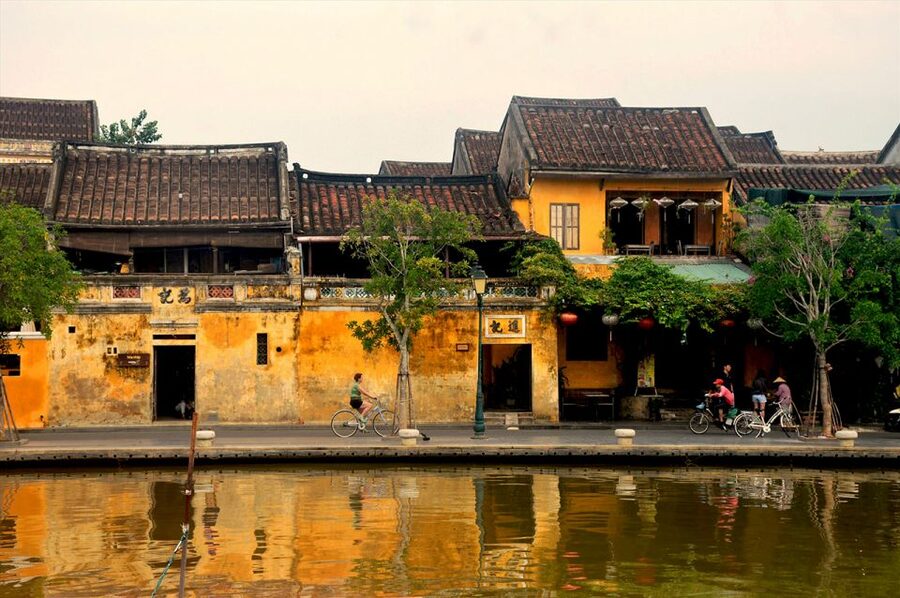
Hoi An sits beside the Thu Bon River on the coastal plain of Quang Nam Province. Its old trading connections brought Chinese, Japanese, French, and other European influences into one compact town. That mix is what gives the historic center its particular look, with timber houses, assembly halls, covered passages, and streets that feel very different from a modern Vietnamese city.
The town has also been known by names such as Lam Ap and Faifo. You do not need a long history lecture to enjoy the place, but those older names help explain why Hoi An feels like a port town shaped by outside contact rather than a single architectural tradition.
This tour is designed as an introduction. You meet your English-speaking guide in your hotel lobby at 8:00 in the morning, walk toward the old town, purchase or receive the required entrance access, and begin the main route. The early start gives you a sensible first look before the heat of the day becomes the main attraction.
The program is not built around a long bus ride or a distant countryside stop. Most of the value comes from walking between nearby sights while your guide explains what you are seeing. That makes the four-hour length useful for a first morning, especially if you want time later for your own plans.
More Ancient Town walks in Hoi An:
- Hoi An Ancient Town Walking Tour with a Local
★ 5.0 · 517 reviews - The Lantern Lady: Traditional Lantern Class in Old Town
★ 4.9 · 444 reviews - Hoi An Ancient Town – Walking Tour with Local Guide
★ 4.9 · 385 reviews
Walking from the hotel into the Old Town

The day begins at your hotel rather than at a hard-to-find street corner. Pickup is available from most centrally located Hoi An hotels, but you need to arrange the exact pickup point when confirming the reservation. Be in the lobby 15 minutes before the scheduled time.
From there, the group walks to the old town. The material for this experience mentions both walking and a bicycle with helmet, so the exact use of the bicycle should be confirmed when you book. Do not assume that the tour is a continuous cycling trip. The stated itinerary is primarily a walking exploration of the historic center.
That distinction matters. Hoi An’s narrow lanes are best seen slowly, with time to look above shopfronts and inside old courtyards. A bicycle can be useful for getting around, but crowded or restricted areas may naturally call for walking.
Leave large bags and luggage at your hotel. The tour specifically does not allow luggage or large bags, and a small day bag is far more practical on a four-hour route through old streets.
Temple Kwan and Phuc Kien Temple
The temple visits give the morning a cultural focus beyond architecture. Phuc Kien Temple, also called the Phuc Kien Assembly Hall, reflects the Chinese community’s presence in Hoi An. An assembly hall was more than a place for quick sightseeing. It served social, cultural, and religious purposes for a community with shared roots.
Your guide is important here. Details about a temple can pass quickly if you only look at rooflines and carved decoration. Ask about the people who built and used the hall, the meaning of the design, and how local religious life fits into Hoi An today.
Temple Kwan is also included among the stops. The supplied details do not specify the exact length of time at each temple, so expect an overview rather than a specialist architectural study. If you have particular interests, such as religious practice, Chinese communities in Vietnam, or decorative art, tell your guide early.
This is one place where a private or small-format experience could feel especially rewarding, but the group size is not specified. You should not book this tour assuming it is private. Ask if that matters to you.
Tan Ky Ancient House and Hoi An’s old architecture
Tan Ky Ancient House offers a close look at the kind of merchant home that makes Hoi An distinctive. The tour description identifies it as a key stop, but it does not promise a detailed room-by-room program or a set amount of time inside.
The larger point is easy to appreciate. Hoi An’s old lanes are lined with buildings shaped by Chinese, Japanese, French, and European influences. You will see how the town’s trading past affected its homes and public buildings, rather than viewing a collection of unrelated monuments.
I would pay attention to the practical layout as much as the decoration. Old merchant houses often tell you how a family lived, worked, welcomed business contacts, and managed a narrow urban plot. Your guide can help turn a pretty facade into a readable piece of town history.
If you like taking photographs, this part of the route should be rewarding, but remember that the morning is shared among several stops. Ask before taking pictures inside cultural sites, and keep your camera from slowing the group.
More half-day trips in Hoi An:
- My Son Sanctuary Half-Day Private Guided Tour- Early Tour
★ 5.0 · 222 reviews - Hoi An: Half-day Excursion To My Son Sanctuary Tour
★ 4.5 · 130 reviews - My Son Sanctuary Half-day Journey
★ 4.0 · 97 reviews - Hoi An Half-Day Street Food Guided Tour – HFE
★ 5.0 · 83 reviews
The 400-year-old Japanese Covered Bridge
The Japanese Covered Bridge is the headline sight, and rightly so. It is described as about 400 years old and is one of the clearest reminders of Hoi An’s connections with Japan.
The bridge is not simply a crossing to tick off. Its covered design makes it an architectural marker, a public passage, and a symbol of the town’s international past. Your guide can explain why it matters and how it fits into the surrounding old quarter.
Expect this stop to be popular and visually busy at times. The experience details do not promise a quiet photo session or exclusive access. You will get more from the bridge if you listen first, then take a few careful photos instead of trying to control the whole scene.
The Japanese Bridge also helps you understand Hoi An’s scale. Major sights are close enough to connect on foot, but each one represents a different strand of the town’s past. That compact arrangement is a major reason this half-day format works.
Cultural show rooms and the local fish market
The cultural show rooms add another layer to the morning. The information provided does not specify the exact performances or exhibits, so I would treat this as a chance to see cultural presentation within the old-town route, not as a guaranteed full stage production.
The local fish market offers a different kind of stop. Here, the town is not presented only as a preserved historic district. You get a glimpse of daily commercial life and the way the old town connects with local food and trade.
Markets can be lively and visually crowded, so stay close to your guide and keep personal items secure. The tour data does not promise tastings or food purchases, and beverages and meals are not included. You should not arrive expecting a market breakfast as part of the price.
This contrast between heritage buildings and ordinary commerce is one of the best features of the route. Hoi An is more useful to understand when you see both the protected old streets and the local activity around them.
Shopping after the main sightseeing
You have free time for shopping after the guided visits, if the schedule allows. That wording matters. Shopping is an opportunity at the end, not a guaranteed extended shopping session with a fixed number of stores.
Hoi An is well known for its old-town shopping, but the tour does not include shopping costs. Clothing, crafts, souvenirs, and personal purchases are your responsibility. The guide can help with navigation and, according to the experience details, Tea also helped with shopping and photographs.
The shopping time is most useful if you already know what you want. Make a short list before the tour, then ask your guide for help finding the right area. Do not let browsing eat the whole morning if you still want a calm finish and a prompt return to your hotel.
A guide can also help you compare options, but you remain responsible for the final purchase. Keep an eye on time and remember that personal expenses are not included.
Guides who add more than directions

The strongest feature in the available feedback is the quality of the guides. Huy is described as a proud local of Hoi An who explains the city with warmth and enthusiasm. Tea is praised for giving thorough information, taking many photographs, showing the sights, and helping with shopping. Minh is a local guide who connects the town’s history with family life, country life, and Vietnamese culture.
Those details point to the kind of guiding you should expect: not just directions from one sight to the next, but answers to questions about local life. I would use the first few minutes to tell your guide what interests you most. That might be architecture, religion, food markets, photography, shopping, or the story of Hoi An as a trading town.
The guide names are not a guarantee of your assigned guide. The listed language is English, and the provider is Vietnam Travel Group VNTG. Ask who will lead your tour when confirming if a particular guide matters to you.
A guide who knows the town personally can also make the difference when you have limited time. Huy, Tea, and Minh are each singled out by name in the supplied feedback, with especially strong praise for personal attention, explanations, photography, and local perspective. The overall rating is 4.5 from eight reviews, a small sample but a positive signal.
What $55 per person really covers
At $55 per person, this is not the cheapest way to wander Hoi An. The value depends on how much help you want during your first visit.
The price includes:
- Hotel pickup and drop-off
- An English-speaking guide
- Bicycle and helmet
- All entrance fees
- Tax and service charges
- Travel insurance
That package removes several small costs and decisions. You do not have to work out which entrance tickets are needed, find the old town from your hotel, or arrange a return trip after the walk. For a first morning in Hoi An, that convenience has real value.
The price does not include drinks, meals, shopping, visa fees, hotel early check-in or late check-out, or personal costs such as telephone use and laundry. A single supplement may also apply. Costs caused by major disruptions, such as typhoons, floods, flight delays, strikes, accidents, or medical evacuation, are excluded.
For a visitor who likes independent wandering and already understands Hoi An’s layout, $55 may feel high for four hours. For you, the price makes more sense if you want context, entrance fees handled, and a structured introduction before exploring alone.
Timing, comfort, and the mobility question
The scheduled tour runs from about 8:00 to 11:00 in the supplied program, although the booking information describes the activity as four hours and asks you to check available start times. Confirm the exact departure and return time when booking. The difference may reflect pickup, ticketing, or scheduling details.
Wear comfortable shoes. That is the one item specifically recommended, and it is sound advice for narrow old-town streets. Bring water if you need it, since beverages are not included.
The activity is marked wheelchair accessible, but the additional information also says it is not suitable for people with mobility impairments. Those two statements do not fully agree. Because the route involves walking through old lanes, entering historic sites, and possibly using a bicycle, you should contact the provider before booking if you use a wheelchair, walker, or have difficulty walking.
Children aged one and younger are complimentary when accompanied by a paying adult. No other child pricing details are provided, so confirm the cost for older children.
The tour offers free cancellation up to 24 hours before the start and a reserve-now, pay-later option. Those policies are useful if your Vietnam plans may shift, but they do not remove the need to confirm pickup details.
Who should book this Hoi An tour
I would recommend this experience to a first-time visitor who wants a clear introduction without giving up a full afternoon. It is also a good fit if you prefer learning from a local guide instead of reading signs or piecing together the town’s story on your own.
It suits you especially well if you want:
- A morning activity close to central Hoi An hotels
- Major historic sights in one compact route
- A guide who can answer questions about local life
- Entrance fees and hotel transport included
- Some time for shopping after the formal sightseeing
I would think twice if you want a slow, photography-first visit, a food-focused tour, or a long shopping session. The schedule covers several sights, so each stop may receive an overview rather than an extended visit.
I would also avoid booking without clarification if you have mobility concerns. The walking requirements and the conflicting accessibility notes deserve a direct question before payment.
Should you book it?
Book this tour if you want Hoi An explained rather than merely photographed. The Japanese Covered Bridge, Phuc Kien Temple, Tan Ky Ancient House, market, and cultural show rooms give you a solid first look, while guides such as Huy, Tea, and Minh add the personal local stories that make the old town easier to understand.
Skip it if you are already comfortable navigating Hoi An and would rather set your own pace. At $55, the main value is the guide, structure, included admission, and hotel convenience. For a first morning in town, that is a fair trade, provided you are ready for active walking and keep your shopping ambitions modest.
FAQ
Where does the tour start?
The tour starts at your hotel. Pickup is available from most centrally located Hoi An hotels, and you should arrange the exact pickup point when confirming your reservation.
What time does the tour begin?
The supplied program begins at 8:00, but the activity page asks you to check available starting times. Confirm your exact pickup time when booking.
How long does the activity last?
The activity is listed as four hours. The stated program runs from 8:00 to 11:00, so confirm the exact schedule for your booking.
What sights are included?
The route includes Temple Kwan, Phuc Kien Temple, Tan Ky Ancient House, the Japanese Covered Bridge, cultural show rooms, the local fish market, and the Old Town shopping area.
Is hotel transportation included?
Yes. Hotel pickup and drop-off are included, with pickup available from most centrally located Hoi An hotels.
What is included in the price?
The price includes an English-speaking guide, bicycle and helmet, entrance fees, hotel pickup and drop-off, tax and service charges, and travel insurance.
What should I bring?
Bring comfortable shoes. Large bags and luggage are not allowed on the activity.
Can I cancel the reservation?
Yes. You can cancel up to 24 hours in advance for a full refund. The activity also offers reserve now and pay later booking.
Just added in Hoi An
- Hoi An: Ylang Ylang Spa Experience (Free pick up for 2pax++)★ 4.5 · 17 reviews
- Vietnamese Cooking Class with Local Family in Hoi An★ 4.9 · 20 reviews
- Hoi An Countryside Bicycle Tour : 25 Km Real Vietnam★ 5.0 · 12 reviews
- Vietnamese Coffee Making Class in Hoi An★ 5.0 · 4 reviews
- Vegetarian Cooking Class with Local Family in Hoi An★ 4.6 · 5 reviews
- Vegetarian Cooking Class W Optional Basket Boat from Hoi An★ 4.5 · 5 reviews
- My Son Sanctuary Private Tour – Early Morning or Half Day Tour★ 5.0 · 15 reviews
- Traditional Vietnamese Cooking Class in Leina Cookery★ 5.0 · 12 reviews
Hoi An Ancient Town Walking Tours, compared.


The Lantern Lady: Traditional Lantern Class in Old Town
Read our review →

Hoi An Night Market – Ancient Town street food tours by Night
Read our review →
Hoi An Ancient Town – Night Market Street Food Tours By Night
Read our review →

Browse the lists this tour appears in